Oshyn Home Page
  • expertise
    • Overview
    • Contact Us |
    • Latest work: www.miramax.com
  • solutions
    • Overview
    • Content Management
      • Choosing a CMS
      • Site Migration
      • Sitecore Consulting
      • EPiServer CMS Consulting
      • Jahia Integration
      • Legacy CMS Solutions
      • Drupal Development
      • Common Issues
      • Training
    • Web Strategy
    • Mobile Platforms
    • Social Media
    • E-commerce
    • Portals & Collaboration
    • SOA
    • Contact Us |
    • Latest work: www.miramax.com
  • work
    • Overview
    • Client Quotes
    • Contact Us |
    • Latest work: www.websense.com
  • resources
    • Overview
    • News & Events
    • Newsletters
    • Blog
    • White Papers
    • Success Stories
    • Press Kit
    • Contact Us |
    • Latest work: www.disneydvd.com
  • partners
    • Overview
    • Agency Partner Program
    • Technology Partners
    • Contact Us |
    • Latest work: www.nea.org
  • company
    • Overview
    • Contact
    • Careers
    • Leadership Team
    • News & Events
    • Social Responsibility
    • Contact Us |
    • Latest work: www.icon4x4.com
  • Tweet
Thursday, December 15, 2011  /   Dario Mora Dario Mora
Author Page
close

Dario Mora


Dario is a Senior Frontend Developer at Oshyn.

JavaScript Navigation using Hash Change "#"


Modern web applications often load data or changes in the document object model (DOM) via AJAX without leaving the original page, to create a desktop-like experience. To do that we can take advantage of the URL hash value and the benefits it give us, including less bandwidth used by the client, faster response time and eventually a more interactive application feeling. By inserting a hash character into the URL we can pick up the string following it and use it as a value in AJAX requests. We can also create a listener event to check for a hash being added to a URL and use it to activate a custom JavaScript.

The hash symbol can enable backward and forward browser navigation support in a web page, without the need to reload the entire page. Using JavaScript and the “#” we can enable the browser history for Ajax calls and for DOM updates.

The content after the “#”in the URL is not sent to the server, since it has a hash in the URL. The content itself is accessible using JavaScript, using the variable window.location.hash. It has two big advantages when used with AJAX: first, it enables the browser history even if the web page is based on AJAX (this depends on the implementation, of course). Second, you can “share” or “bookmark” the link, so even if it is an Ajax call, it can be launched when you enter the page with the same link and with the same hash.

With JavaScript functions running and updating our DOM, we can change the hash with each JavaScript function. This means when the user hits the "back" button, the hash goes to the previous hash, and now since we have a listener, we can reload/re-render the previous content.

The most common form that uses the hash, and that many already know is to make a scroll down on the screen to the HTML tag with the ID assigned. For example:

If the hash in the URL indicates, for example: #end (http://www.domain.com/page.html#end), the browser will scroll the screen to the item that has that ID.

Here, I will show you how to build a page that shows a set of images and when an image is clicked, it will show an overlay. With every event, the URL is going to change.
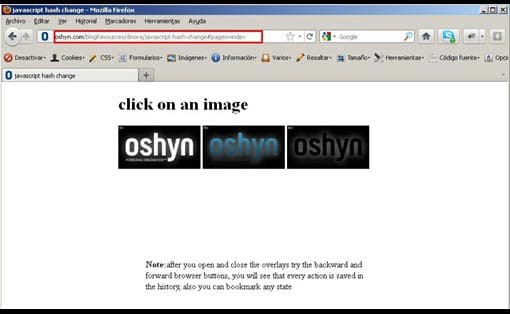
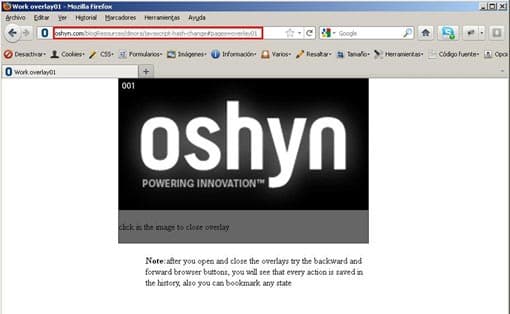


The Code

First, we would need to include the jQuery library:

<!DOCTYPE html>
<html lang="es">
<head>
 
<script src="js/jquery.min.js" type="text/javascript"></script>
 
</head>
<body>
 
</body>
</html>


After that we will need to add the HTML structure:

<!DOCTYPE html>
<html lang="es">
<head>
 
<script src="js/jquery.min.js" type="text/javascript"></script>
 
</head>
<body>

 <div style="width: 500px; margin: 0pt auto;">
 <div>
 <h1>click on an image</h1>
 </div>
 <div id="demos" class="content">
 <div class="pics" id="slideshow">

 <a href="#overlay01" onclick="change_hash('overlay01'); return false; " ><img  alt="" src="Images/logo001.png" /></a>
 <a href="#overlay02" onclick="change_hash('overlay02'); return false; " ><img  alt="" src="Images/logo002.png" /></a>
 <a href="#overlay03" onclick="change_hash('overlay03'); return false; " ><img  alt="" src="Images/logo003.png" /></a>
 </div>

 </div>
 </div>

<div class="overlays" style="width: 500px; margin: 0pt auto;">
 <div class="item" id="overlay01" >
 <img alt="" src="Images/logo001.png" />
 <p class="text">
 click in the image to close overlay
 </p>
 </div>
 <div class="item" id="overlay02" >

 <img alt="" src="Images/logo002.png" />
 <p class="text">
 click in the image to close overlay
 </p>
 </div> 
 <div class="item" id="overlay03" >
 <img alt="" src="Images/logo003.png" />
 <p class="text">
 click in the image to close overlay
 </p>
 </div>
 
</div>
</body>
</html>


In the body structure we have a div with the class “pics” which holds a set of images and a div with the class “overlays” which holds the overlay elements that are going to be shown when an image is clicked

Now we have to define the JavaScript code:

<script type="text/javascript">
$(function() {

//set up hash detection 
$(window).bind( 'hashchange', function(e) {
 var hash = '';
 var hashlenght = 0;
 hashwith = '';
 if (location.hash == ''){
 location.hash = '#pages=index';
 document.title = 'Work Index';
 }

 hash = location.hash;
 hashlenght = hash.length;
 hashwith = '#'+hash.substring(7, hashlenght);
 hash = location.hash.substring(7, hashlenght);
 if(hashwith != "#"+'index'){
 show_overlay(hash);
 document.title = 'Work '+hash;
 }
 else{
 close_overlay();
 
 }
 
 });

 $(window).trigger( 'hashchange' );

 $(".overlays .item img").each(function(){
 $(this).click(function(){
 close_overlay();
 });
 });

});

function close_overlay(){
 $(".overlays .item").each(function(){
 if($(this).css('display') == 'block'){$(this).hide();}
 });
 location.hash = '#pages=index';
}

//function to show overlay
function show_overlay(aux){
 $("#"+aux).show();
}

//function to change hash
function change_hash(aux){
 location.hash = '#pages='+aux;
 document.title = 'Work '+aux;
}

</script>


The JavaScript code will:

  • Bind a handler to the window.onhashchange event. Each time the hash changes is compared to the hash string to check if the page is in its original state or if an overlay was clicked
  • The code receives the hash string to check if an overlay was clicked in the page, to execute a “show_overlay()” or “close_overlay()” function.
//set up hash detection 
$(window).bind( 'hashchange', function(e) {
 var hash = '';
 var hashlenght = 0;
 hashwith = '';
 if (location.hash == ''){
 location.hash = '#pages=index';
 document.title = 'Work Index';
 }
 
 hash = location.hash;
 hashlenght = hash.length;
 hashwith = '#'+hash.substring(7, hashlenght);
 hash = location.hash.substring(7, hashlenght);
 if(hashwith != "#"+'index'){
 show_overlay(hash);
 document.title = 'Work '+hash;
 }
 else{
 close_overlay();
 
 }
 
 });
 
  • Trigger all bound window.onhashchange event handlers
$(window).trigger( 'hashchange' );
  • Assign a function to close an opened overlay when the image in the overlay is clicked
$(".overlays .item img").each(function(){
 $(this).click(function(){
 close_overlay();
 });
});
  • Function to close an opened overlay
function close_overlay(){
 $(".overlays .item").each(function(){
 if($(this).css('display') == 'block'){$(this).hide();}
 });
 location.hash = '#pages=index';
}


  • Function to show an overlay
//function to show overlay
function show_overlay(aux){
 $("#"+aux).show();
}
  • Function to change the hash
//function to change hash
function change_hash(aux){
 location.hash = '#pages='+aux;
 document.title = 'Work '+aux;
}


Check out the demo here

Although the hash can have a powerful uses, it should not be the replacement of basic friendly URLs and permalinks that we all know. Google does not take into account the hash when indexing a page, the following pages will appear the same to Google and other search engines, and will not help with indexing and SEO:

http://www.example.com/seccion/#Com45

http://www.example.com/seccion/#445532q

http://www.example.com/seccion/#file.html

Trackback Link
http://www.oshyn.com/BlogRetrieve.aspx?BlogID=1906&PostID=210317&A=Trackback
Trackbacks
Post has no trackbacks.

Pages: Previous Next

TwitterFacebookLinkedIn
ajax rotator

Blog Authors

Christian Burne   Christian Burne  
Subscribe Subscribe Subscribe Subscribe Subscribe
OTHER CATEGORIES
  • ALL

  • General

  • Web Content Management

  • Sitecore CMS

  • Open Text

  • Jahia

  • Drupal

  • EpiServer

  • SOA

  • Social Media and Mobile

  • Software Development

  • Visit Bloggers Profiles

RELATED POSTS
  • Creativity is Not Enough: 3 Reasons Why
  • Managing Complexity in the Web Design Process
  • Why you don't have to rank #1 in search
  • 5 Ways a Discovery Phase can help keep your web design projects sane
  • Top 3 Mistakes Agencies and In-House Departments Make on Web Projects
  • Foundation Framework: A responsive front-end framework for your site
  • Introduction to Responsive Web Design
  • LESS Beginner’s Guide – A look into the CSS Preprocessor
  • Pros and Cons of using jQuery Mobile for your site
  • Seven Predictions for 2013 from Oshyn

WHITE PAPERS

    Web Content Management, Social Media, Content: Three Kings for Your Website Web Content Management, Social Media, Content: Three Kings for Your Website (846 KB)
    Companies pursuing online marketing success, including Social Media, can increase the power of their online presence with right strategy and technology to maximize online visibility and engagement. Download this FREE white paper on the WCM, Social Media, and Content triad.

    Drupal Performance Tuning Drupal Performance Tuning (1213 KB)
    In this Free White Paper Oshyn evaluates Drupal Performance Tuning, sharing the results of testing response time and Requests Per Second (RPS) that a server can hold before the response rate becomes unacceptable. In this paper you will learn about optimizing performance of a website through changes to settings and the server.

    Enterprise Drupal: Social Media, Mobile, and Rich Media in your Website Enterprise Drupal: Social Media, Mobile, and Rich Media in your Website (1015 KB)
    In this free WCM white paper, Oshyn examines advanced Drupal capabilities: Multisite Environment, Access Control and Security, Enhanced User Profiles, Custom Breadcrumbs, Mobile Support, Podcasts, Advanced Multimedia, Locations and Maps, Internationalization and Locale based content, Events and Scheduled Tasks, Rules Actions and E-Commerce Solutions.

    Drupal Multilingual Drupal Multilingual (636 KB)
    There are several multilingual installation methods for Drupal. In this free white paper Oshyn evaluates and recommends several methods of using Drupal Open Source CMS to manage websites in multiple languages.

    Drupal Social Media Drupal Social Media (1297 KB)
    Looking for an Open Source CMS to for “Social Media Optimization” of your website? Download this free white paper, “Drupal and Social Media”, to learn about the extensive Social Media this Open Source CMS offers to create a dynamic and engaging website and online community.

    Drupal Multisite Options Drupal Multisite Options (427 KB)
    There are several multisite installation methods for Drupal. In this free white paper Oshyn evaluates and recommends several methods of using Drupal Open Source CMS to manage multiple sites.

    Open Source CMS: Is It Right for your Organization Open Source CMS: Is It Right for your Organization (496 KB)
    In this free white paper, “Open Source CMS: Is It Right for your Organization?” we share an in-depth look at the pros and cons of using Open Source Content Management Systems (CMS) or Open Source Web Content Management (WCM) platforms. Oshyn helps clients select CMS/WCM solutions based on the specific requirements of each client.

    Affiliate Content Sharing in a CMS/WCM World Affiliate Content Sharing in a CMS/WCM World (273 KB)
    The Content Editors at your company have created GREAT content! Now how do you share it? In this Free white paper learn several methods for using a Content Syndication tool to automatically repurpose content and how Content Sharing can generate business value.

    Sitecore and Social Media - An Interactive Web Content Management Platform Sitecore and Social Media - An Interactive Web Content Management Platform (898 KB)
    Social Media has revolutionized how people interact with business. In this white paper Oshyn’s Lead Sitecore Developer, Prasanth Nittala, discusses key points from the perspectives of marketing and Web development that make Sitecore a compelling choice for engaging in Social Media via your website. This Sitecore white paper draws from Oshyn’s expertise as a certified Sitecore partner, helping organizations understand the distinct capabilities offered by Sitecore CMS.

    The Business Case for Leveraging Open Text Web Solutions Delivery Manager The Business Case for Leveraging Open Text Web Solutions Delivery Manager (451 KB)
    This free white paper explores the evolving needs of small and medium size businesses and explains how the Open Text Web Solutions Delivery Manager (formerly RedDot LiveServer) can help businesses build their brand, reputation, and client base. This white paper examines strategies, key points and tips to leverage the features available in Open Text Web Solutions (RedDot CMS) to achieve an impactful user experience and to maximize visitor engagement through a reliable and powerful implementation.

    Open Text Best Practices: Part One Open Text Best Practices: Part One (763 KB)
    Authored by Oshyn Senior Consultant, Adaeze Okorie, this free CMS white paper draws from Oshyn’s vast experience as an Open Text Certified Partner, in helping organizations define strategies to meet business goals while implementing Open Text Web Solutions (RedDot CMS). Specifically in this free white paper Adaeze Okorie discusses strategies, key points and tips to leverage the features available in Open Text Web Solutions (RedDot CMS) to achieve an effective, reliable and robust implementation.

    Improving the ROI of Business Software: Service Oriented Architecture from a Business Perspective Improving the ROI of Business Software: Service Oriented Architecture from a Business Perspective (398 KB)
    Software selection and technology decision making should no longer be left to the IT department alone. By gaining an understanding of Service-Oriented Architecture, business people outside of the IT department will be better positioned to maximize the ROI of the company's technology platforms. Download this free white paper to learn more.

    Getting Over Social Media Marketing Paralysis for B2B Getting Over Social Media Marketing Paralysis for B2B (2254 KB)
    Many companies are well aware that Social Media has become critically important to engaging audiences and promoting online "presence" while some wonder how to approach their C-level executives and prove that it is not all hype. With so many ways to engage in Social Media, how can they get buy-in and begin execution with so many different venues and tools available? Staying on the sidelines and becoming a latecomer might make it more difficult to create a convincing "social" presence. Put the ove

    Performance Tuning Open Text Web Solutions Management Server and Delivery Server Performance Tuning Open Text Web Solutions Management Server and Delivery Server (235 KB)
    If you've made an investment in Open Text Web Solutions (formerly RedDot) Web Content Management products, you’ve undoubtedly experienced performance issues. While every CMS requires tuning, Open Text Web Solutions - RedDot is especially susceptible to mis-configuration and poor performance as the out-of-the-box installation comes untuned and ready for Development Environments only. In this FREE white paper we share performance tuning expertise as an Open Text Certified Partner that has optimize

    The Business Case for Leveraging Open Text Web Solutions Within Higher Education The Business Case for Leveraging Open Text Web Solutions Within Higher Education (430 KB)
    Academic institutions have a long reputation for being slower to adopt new technologies for their audiences. However, many schools are taking serious steps in improving the online experience they are providing. This white paper explores the unique needs of the higher education market, applying new tools & trends and specifically how the Open Text Web Solutions’ Delivery Manager (formerly known as RedDot LiveServer) can be leveraged to achieve those goals.

    SEO Best Practices within a Content Management System SEO Best Practices within a Content Management System (712 KB)
    In this free white paper, we share Search Engine Optimization (SEO) tips and best practices to follow when implementing a Content Management System (CMS). Certain features and functionality will help your content editors make website changes faster while minimizing the risk of human error. Download this free white paper to learn strategies to improve search engine rankings.

    Best Practices for Sitecore CMS Best Practices for Sitecore CMS (1121 KB)
    Sitecore CMS is an extensive Web Content Management (WCM) platform for the mid-market. It offers reduced IT expenditures, a streamlined content lifecycle, and a return of content control to the subject matter experts. The newest incarnation of Sitecore CMS version 6.0 is a mature product that incorporates standard social media components such as wikis, blogs, RSS syndication and “e-mail a friend” features.

    Optimizing SEO in your CMS (WCM) Optimizing SEO in your CMS (WCM) (3108 KB)
    Oshyn's Christian Burne spoke in depth about SEO in CMS at the Gilbane San Francisco Conference on June 3rd, 2009. Christian discussed the pressues of keyword competition and how the CMS can add tremendous power to climbing Google SERPs and other search engine rankings. The presentation was later part of a featured article on CMSWire. We've made the presentation available in PDF format. Download now to learn more about strategies for using your CMS to optimize SEO.

    The Best CMS for You: Tips on How to Select Your Next CMS The Best CMS for You: Tips on How to Select Your Next CMS (909 KB)
    As websites continue to grow in size, features and functionality, the visitors to these websites are also becoming more demanding and have higher expectations than ever before. Companies who committed valuable time and resources to web strategies just five years ago are finding they must re-evaluate and explore new options as their content, features and online offerings must keep pace with the constant and rapid movement in the digital marketplace. For many of these companies, there is a strong.

    Oshyn Sample Voluntary Product Accessibility Template (VPAT) Oshyn Sample Voluntary Product Accessibility Template (VPAT) (741 KB)
    Section 508 requires that when federal government and agencies procure, develop, and maintain or use electronic and information technology (EIT), they must ensure that it is accessible and in compliance with Section 508 standards developed by the Architectural and Transportation Barriers Compliance Board (Access Board). Oshyn understands these requirements and has delivered reports like these countless times.

    G SEO Best Practices Guide G SEO Best Practices Guide (349 KB)

    Sitecore CMS Implementation Best Practices Sitecore CMS Implementation Best Practices (481 KB)

    Twitter Facebook LinkedIn Featured in Alltop
    Oshyn, Inc.17785 Center Court Drive N Cerritos, CA 90703    1.888.483.1770 newbusiness@oshyn.com
    2013 Copyright Oshyn. All rights reserved.
    • View Mobile Version
    • Terms of Use
    • Privacy Policy
    • Contact Us
    x
    • Contact Us Oshyn 1.888.483.1770
      Have Oshyn Call Me Have Oshyn call you
      Request Further Information Request further information

      Submit an RFP Submit an RFP